Threat model¶
This document is the single source of truth for IronClaw's threat model. Versioned with the code and linked from the README, SECURITY.md (the disclosure policy), and docs/security.md (the trust-story map). Those pages summarize and point here; they do not restate the model. The scope in §8 ("what counts as a vulnerability") and the non-goals in §9 are the authoritative reference the disclosure policy defers to. Every release also ships a signed containment report that machine-verifies the core §5/§8 invariants held for that exact version — see docs/security.md.
IronClaw assumes the agent inside the sandbox is potentially compromised — by prompt injection, a poisoned tool result, or a hostile model output — and designs the trust boundary so that a compromised agent cannot escalate. The host is trusted; the agent is not. Everything below follows from that single asymmetry.
1. Scope and core assumption¶
- Trusted: the host OS and root, the control-plane binary, the maintainer, the gVisor runtime, and the integrity of the build/release pipeline.
- Untrusted: the sandboxed agent and everything it emits (tool calls, outbound messages, capability-change requests), every inbound chat message, and every byte returned by an approved external API.
- Goal: a fully-compromised agent still cannot read another session's data, change its own configuration, reach the host filesystem or arbitrary network, obtain a host-held secret, or bypass the human-approval gateway.
What is explicitly not in scope (a compromised host, a malicious maintainer, physical attacks, model "alignment") is enumerated in §8–§9 so that disclosure stays sane.
2. Assets¶
| Asset | Why it matters |
|---|---|
| User conversation data | At rest in the per-session queues; the primary confidentiality target. |
| Cross-session isolation | One session (or agent group) must never read another's queue or workspace. |
| Host secrets | The Anthropic API key, the keystore master key, per-session 256-bit queue keys, the API bearer token — none may reach the sandbox. |
| Gateway integrity | The guarantee that no persona/tools/packages/wiring/permissions/mounts/create_agent change applies without a human decision. |
| The host machine | Filesystem, processes, and network reachability of the box the control-plane runs on. |
| Model & egress budget | Cost and rate of model calls and approved-egress calls. |
3. Trust boundaries and data flow¶
The static diagram below is the visual companion to this section: the untrusted sandbox on the left, the trusted host on the right, the only crossings between them (host-owned unix sockets and the per-session encrypted queues), and a legend that maps each red-team escape attempt from the escape harness to the boundary control that contains it. The security and isolation page walks through the same picture in prose; the Mermaid source that follows is these same boundaries in text form.
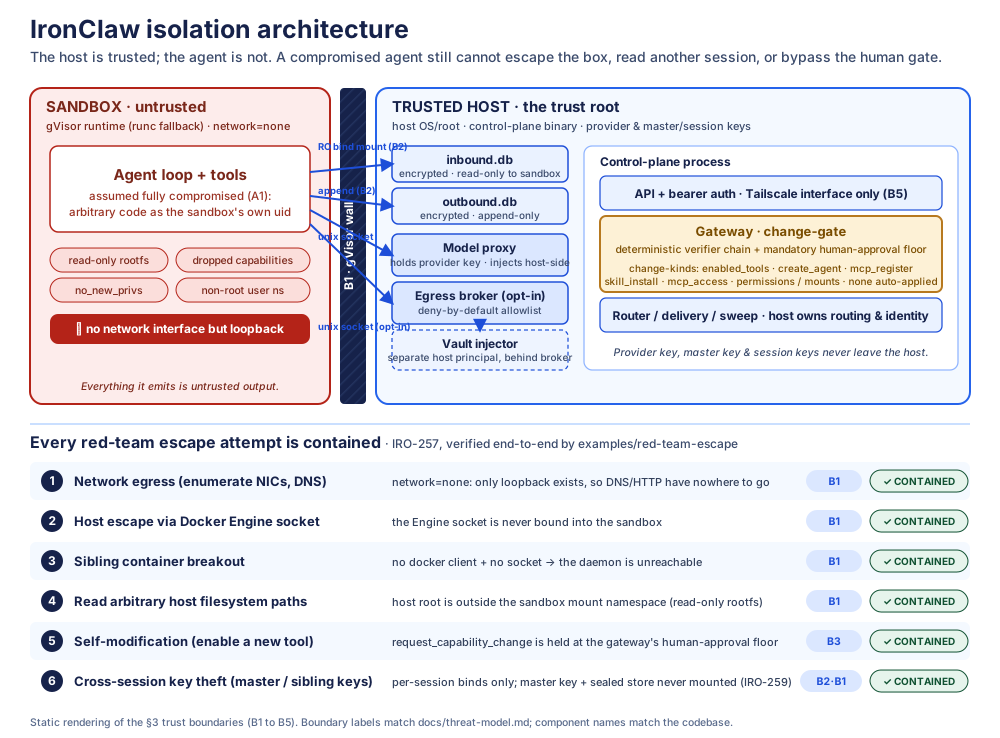
The boundaries this document analyzes with STRIDE:
- B1 — host ↔ sandbox: the gVisor wall. The only crossings are two host unix sockets (model proxy, and the opt-in egress broker) and the bind-mounted queue files. No NIC exists inside the sandbox.
- B2 — control-plane ↔ agent: the per-session encrypted queue pair. Inbound is read-only to the agent; outbound is append-only.
- B3 — agent ↔ agent (a2a): one agent group messaging another, and the
approval-gated
create_agentchange (RFC-0004). - B4 — egress broker ↔ network: the bounded relaxation of
network=nonefor operator-approved external APIs (see §7). - B5 — admin ↔ control-plane (supporting): the mesh-only API plus bearer token.
4. Adversaries¶
| # | Adversary | Capability assumed |
|---|---|---|
| A1 | Compromised sandbox agent (primary) | Full control of the agent loop: arbitrary tool calls, outbound messages, and change requests. |
| A2 | Malicious external sender | Can send any inbound chat content (the prompt-injection vector that produces A1). |
| A3 | Tailnet-adjacent attacker | Has a foothold on the private mesh and can reach the API port. |
| A4 | Offline / disk attacker | Can read the state directory and queue files at rest. |
| A5 | Malicious approved-egress host | A host the operator added to the egress allowlist that then behaves adversarially. |
A compromised host or root (A0) is not modeled — it is the trust anchor (§1).
5. STRIDE by boundary¶
Each table is a STRIDE pass (Spoofing, Tampering, Repudiation, Information disclosure, Denial of service, Elevation of privilege) for one boundary, with the control that addresses it.
B1 — host ↔ sandbox (the gVisor wall)¶
| STRIDE | Threat | Mitigation |
|---|---|---|
| S | Agent impersonates the host/model to itself | Host services are reached only over host-owned unix sockets bound into the sandbox; the agent cannot forge the other end. |
| T | Agent edits its own runtime/source to change behavior | Compiled Go binary, no interpreter, read-only rootfs; there is no source in the box to rewrite. |
| R | Agent denies an action it took | Every change request and model/egress call is audited host-side, outside the sandbox's reach. |
| I | Agent reads a host secret (Anthropic key, master key) | Secrets stay host-side; the model proxy injects the API key into the outbound call — the sandbox never sees it. Session keys arrive via tmpfs at launch, never an env var or the image. |
| D | Agent exhausts host resources | gVisor resource limits; host respawn crash-loop backoff; sweep reclaims stale sandboxes. |
| E | Sandbox escape to the host | gVisor (runsc): dropped capabilities, no_new_privs, non-root user namespace, read-only rootfs. |
B2 — control-plane ↔ agent (the encrypted queues)¶
| STRIDE | Threat | Mitigation |
|---|---|---|
| S | Agent writes a message attributed to another sender/session | The host owns routing and stamps identities; the agent only appends to its own outbound queue. |
| T | Agent writes the inbound queue it should only read | Three independent layers: Go interface segregation (no write method), PRAGMA query_only, and a read-only OS bind mount. |
| R | Disputed message history | Append-only queues with monotonic sequence; host-side audit. |
| I | Cross-session / at-rest queue reads (A4) | Per-session encrypted SQLite (raw 256-bit key, pinned cipher params); no plaintext on disk; wrong key fails closed. |
| D | Agent floods the outbound queue | Sweep + delivery backpressure; per-session isolation bounds blast radius to one session. |
| E | Agent uses the queue to drive a privileged host action | Queues carry data, not commands; privileged needs must take the gateway path (B3 / change requests), which the queue cannot shortcut. |
B3 — agent ↔ agent (a2a + create_agent)¶
| STRIDE | Threat | Mitigation |
|---|---|---|
| S | Agent spoofs another agent group's identity | Group identities are host-assigned in the registry; a2a routing is mediated by the control-plane, not peer-to-peer. |
| T | Agent tampers with another group's config via a message | a2a is data only; config changes for any group still require a gateway-approved ChangeRequest. |
| R | Untraceable agent-to-agent traffic | a2a flows through host routing/delivery and is audited like any other message. |
| I | Agent reads another group's data by messaging it | Delivery respects destination allowlists and access checks; no shared queue is exposed. |
| D | Agent fans out messages to amplify load | Routing/delivery is host-controlled; sweep and per-session limits bound it. |
| E | Agent provisions a new, over-privileged agent (create_agent) |
create_agent is privileged and always routed through the gateway's mandatory human-approval floor — a new agent is a new trust principal and is never auto-approved (RFC-0004). |
B4 — egress broker ↔ network¶
| STRIDE | Threat | Mitigation |
|---|---|---|
| S | Agent reaches an unapproved host by spoofing a target | Forwarding is matched against an explicit host allowlist; an unapproved host returns 403. |
| T | Agent rewrites the egress destination/allowlist | The sandbox cannot mutate the allowlist; additions/removals clear the gateway and are logged. |
| R | Deniable exfiltration | Every request — allowed or denied — emits an audit record (host, path, method, status, byte counts, duration). |
| I | Exfiltration to an attacker-controlled endpoint | Deny-by-default allowlist; empty allowlist forwards nothing; HTTPS only. Residual risk to approved hosts is accepted and bounded (see §7). |
| D | Agent saturates an approved host / the link | Per-request audit makes abuse visible; rate caps are tracked future work (§9). |
| E | Broker is used to launder access to a host-held credential | The broker injects no host secrets and forwards only the request's own headers — it cannot grant access the sandbox does not already hold. Not a credential vault (an explicit non-goal). |
B5 — admin ↔ control-plane (supporting)¶
Spoofing/EoP from the network: the API binds only to the Tailscale interface
(no public port), and an optional bearer token (constant-time compared) means a
foothold on the tailnet alone (A3) is not enough to drive the gateway. The
/healthz and /readyz probes are the only unauthenticated endpoints.
6. Privilege matrix¶
What each principal can do. gateway = only via a human-approved ChangeRequest.
| Capability | Sandbox agent | Control-plane | Admin (human) | External sender | Approved egress host |
|---|---|---|---|---|---|
| Read its own session queue | ✓ | ✓ | — | — | — |
| Read another session's queue | ✗ | ✓ | — | ✗ | ✗ |
| Write the outbound queue | append-only | ✓ | — | ✗ | ✗ |
| Write the inbound queue | ✗ | ✓ | — | via routing | ✗ |
| Change config (persona/tools/wiring/…) | request only → gateway |
apply after approval | approve/reject | ✗ | ✗ |
Provision a new agent (create_agent) |
request only → gateway |
apply after approval | approve/reject | ✗ | ✗ |
| Reach the model | via host proxy | ✓ (holds key) | — | — | — |
| Reach an external network host | only approved hosts, via broker | ✓ | configures allowlist | ✗ | n/a |
| Reach the host filesystem | ✗ (RO rootfs + bind mounts) | ✓ | ✓ | ✗ | ✗ |
| Hold a host secret | ✗ | ✓ | ✓ | ✗ | ✗ |
7. Egress broker¶
The egress broker (internal/host/egress) lets an agent reach operator-approved
external APIs beyond the model host. It is a deliberate, bounded relaxation of
the original "model host only" posture, designed to keep the trust boundary
intact:
- The sandbox stays
network=none. It never gets a NIC. The broker is a second host unix socket bound into the sandbox (alongside the model-proxy socket); every byte still crosses a host choke point. The egress socket is bound only whenSandboxSpec.EgressSocketis set, so the default (HardenedSpec) remains sealed to the model proxy alone. - Deny by default. The broker forwards only to hosts on an explicit allowlist. An empty allowlist forwards nothing; an unapproved host returns 403. In production the allowlist is mutated only after the change clears the gateway's human approval (wired by the daemon).
- Audited. Every request — allowed or denied — emits an audit record (host, path, method, status, byte counts, duration). Allowlist additions/removals are logged.
- HTTPS only, and not a credential vault (an explicit IronClaw non-goal): the broker injects no host-held secrets and forwards the request's own headers, so it cannot launder access to a credential the sandbox does not already hold.
- Agent surface: the opt-in
http_fetchsandbox tool, registered only when an egress socket is configured.
Threat-model review sign-off: reviewed and approved by the maintainer (sole
CODEOWNER, @omerzamir) on 2026-06-16, via the decision to un-gate the egress broker and wire
egress live. Residual risk accepted: a compromised agent can exfiltrate to / pull
from any approved host; this is mitigated by deny-by-default approval and full
per-request audit, and bounded by keeping the sandbox itself network-less.
8. What counts as a vulnerability¶
For disclosure (see SECURITY.md), a finding is a vulnerability if it lets the untrusted agent or an external sender cross a boundary above — concretely, if it allows any of:
- escaping the sandbox to the host (B1);
- reading another session's queue/workspace, or any at-rest plaintext (B2);
- applying a configuration or
create_agentchange without human approval, or otherwise bypassing the gateway (B2/B3); - reaching the host filesystem, or a network host that is not on the approved egress allowlist (B1/B4);
- causing a host-held secret (Anthropic key, master/session keys, API token) to become readable inside the sandbox (B1);
- tampering with or forging audit/queue records (R across boundaries).
A finding is not a vulnerability (so please don't file it as one) if it is:
- the model saying something wrong, biased, or "jailbroken" — that is agent behavior, not a boundary breach (the threat model already assumes a hostile agent);
- data sent to a host the operator explicitly approved on the egress allowlist — that is the feature working as designed (§7);
- anything that requires a compromised host, root, or the maintainer (A0), or physical access — outside the trust model (§1);
- a denial-of-service that requires host privileges to trigger;
- the agent failing to complete a task.
9. Non-goals and documented future work¶
Intentional non-goals of the sealed / network=none design (do not file these as
gaps): in-sandbox web/browser access, package installation / self-modification, and
a credential vault built into the egress broker / trusted core (the broker is
never a secret sink — B4-E). Request-time credential injection via a separate
host-side principal behind the broker — the vault-behind-broker integration — is now
supported under host governance (see §11); building injection into the broker
stays the non-goal. (Multiple model-provider backends were previously listed here
too; they are now supported under host governance — see §10.)
Documented future hardening: per-host egress rate caps; a Kata isolation backend
behind the same Isolator interface; automated (non-human) gateway approval for
low-risk change kinds, with the mandatory-human floor staying the default.
(Response-secret redaction for the egress broker — the model-proxy redaction pattern
applied to egress — is now implemented for the vault path; see §11.)
10. Multi-provider model egress¶
The model proxy (internal/host/modelproxy) supports per-agent-group model
provider selection beyond the original Anthropic-only posture: a group may run on
Anthropic (the default), OpenAI, or OpenRouter. This was a §9 non-goal; it is now
supported as a deliberate, host-governed relaxation that keeps the trust boundary
intact — it reuses the exact same choke point and controls as the single-provider
proxy:
- The sandbox stays
network=none. Every provider is reached through the same host model-proxy unix socket; no new socket and no NIC are added. The sandbox-sideproviderabstraction (internal/sandbox/provider) only ever dials that socket, addressing the real upstream host so the proxy's allowlist matches and routes it. - The host is still the sole authenticator. Each provider's credential lives
only on the host (
ANTHROPIC_API_KEY,OPENAI_API_KEY,OPENROUTER_API_KEY); the proxy strips any sandbox-supplied auth and injects the credential matching the upstream host (MultiInjector). The sandbox holds no provider key — the §1 "host secret" guarantee is unchanged for every provider. - Deny by default, and only what the operator enabled. A provider is reachable
only when its credential is present in the control-plane environment: the proxy
allowlists exactly the enabled providers' hosts, so an un-configured provider
returns 403 like any other unapproved host. Provider selection for a group is
registry config (
AgentGroup.Provider/Model), consumed at sandbox launch; a change to it is a gateway-gated configuration change like any other. - Audited uniformly. The per-request audit record (host, path, method, status, byte counts, duration) and the rate cap apply to every provider, not just Anthropic — multi-provider egress is as observable as the original path. Each provider's key is also registered for response-secret redaction.
Threat-model review sign-off: reviewed and approved by the maintainer (sole CODEOWNER) on 2026-06-17, via the decision to support per-group providers. Residual risk accepted: enabling a provider adds one egress destination and one host-held credential. This is bounded exactly as the egress broker's risk (§7) is — deny-by-default enablement, full per-request audit, host-only credentials, and a sandbox that remains network-less — so it introduces no boundary crossing that the single-provider proxy did not already define.
11. Credential vault behind the broker¶
Long-running agents that call real third-party APIs need credentials for them.
IronClaw supports request-time credential injection — an agent references a
credential by LOGICAL NAME (vault://<cred>/<path>) and never holds a key — without
weakening either of its two most sensitive components. The design is integrate, not
build-into-the-broker: the secret-holding injector is a separate host-side
principal the broker forwards TO, never the broker itself.
- The secret never enters the sandbox. The agent addresses a credential by name and receives only the upstream response; no plaintext credential is ever in the sandbox's address space — the §1 "host secret" guarantee holds for vaulted credentials exactly as for the model key.
- The secret never enters the egress broker — B4-E is unchanged. The broker
forwards a
vault://request's own bytes, by name, to the configured host-local injector endpoint, injecting nothing (internal/host/egress/vault.gostrips any clientAuthorizationand adds only the logical credential name). The injector — a distinct OS principal — is the sole holder of the credential and the only component that attaches it, host-side. The broker's specification and blast radius (§7) are untouched: it is still "not a credential vault". - Deny by default, gateway-gated policy. "Which agent group may use which
credential against which host" is host-side config (
internal/host/registryVaultPolicyStore), read-only to the sandbox and mutated only through the gateway's human-approval path — a policy change is a capability change like any other. An unlisted group/credential/host is refused, and the injector endpoint is itself deny-by-default on the broker allowlist. - Audited end-to-end. A host-generated correlation id
(
internal/host/egress/correlate.go) joins the broker's per-request audit to the injector's injection/policy audit, so a single credential use is traceable across both principals (the §5 Repudiation control, extended). The id is host-authored: a sandbox-supplied value is overwritten, so audit correlation cannot be forged. - Redaction backstop. Even though the broker holds no credential, configured
secrets are scrubbed from responses on the broker→sandbox hop
(
internal/host/egress/redact.go, the model-proxy redaction pattern) so an injected credential can never echo back if an upstream reflects it.
Building a credential vault into the egress broker or the trusted core — making the broker a secret sink — remains a non-goal (§9). The value here comes precisely from keeping injection in a separate, swappable principal: IronClaw's minimal in-tree injector by default, or an operator-vetted external vault (e.g. OneCLI) behind the same broker→injector contract.
Threat-model review sign-off: reviewed and approved by the maintainer (sole CODEOWNER) on 2026-06-17, via the needs-human decision to BUILD the vault-behind- broker integration (credential-vault spike, approved 2026-06-17) and the spike-2 resolution closing its open questions. Residual risk accepted: a vaulted call adds one host-local destination (the injector) and concentrates credentials in that separate principal; this is bounded by deny-by-default per-group policy, end-to-end audit correlation, the response-redaction backstop, and a broker and sandbox that are otherwise exactly as specified — so it introduces no boundary crossing beyond the injector principal the design intentionally adds.
12. Skills / extension system¶
A skill is a host-side, gateway-gated capability bundle — it declares the
persona text, the already-compiled tools, the egress hosts, and the read-only
assets an agent group should be granted. It is data, not code: a skill never
ships a script, interpreter, or post-install hook (the sealed-runtime pillar of
§1). This is the deliberate answer to the peers' extensibility (openclaw's
SKILL.md + ClawHub auto-install, nanoclaw's branch-copy) without reintroducing
either half of the open + auto-install vector those ecosystems were exploited
through.
The skills boundary¶
- Install is a gateway ChangeRequest, never a sandbox action. Two triggers, one
floor. The operator CLI (
ironctl skill add) triggers it out of session; an agent can propose it from chat viarequest_capability_change(kindskill_install, RFC-0006) — the agent NAMES a skill, never authors its content. Either way the host fetches + signature-verifies + validates the named manifest, then synthesizes oneChangePermissionsChangeRequest bundling the declared grants. The change rides the existing verifier chain and theAlwaysRequireHumanfloor exactly like any other capability change — never auto-approved. The in-session proposal is fail-closed: a skill that is unknown, unsigned, out-of-policy, or proposed when skills are disabled is refused host-side and never reaches the gateway. The agent may ask, only a human may grant (thecreate_agent/RFC-0004 posture, B3). - Apply touches config only. On approval the change updates registry / egress allowlist / mount allowlist — it never writes the read-only rootfs or adds an executable. The install payload is structurally incapable of carrying a command, script, or rootfs path (enforced + tested).
- Assets are read-only data. A skill's bundled files mount at
/skills/<name>withnosuid,nodev,noexec; they are read, never executed.
Trust model for third-party skills¶
Third-party skill content is untrusted by default — the same posture as an inbound chat message or an egress response (§1):
- Curated host source, not an open marketplace. Skills resolve only from a
host-configured source (a pinned ref / operator-controlled registry), never an
agent-supplied URL.
open + auto-installis the vector; IronClaw keeps neither half. - Signature verification before display. A skill whose signature does not verify against the configured trust root is refused at fetch time — it never reaches the approval step (minisign/ed25519, fail-closed).
- Manifest validation fails closed. Tools must be a subset of the compiled sandbox registry; egress entries must be bare hostnames (no wildcards); assets must be relative in-bundle paths. Any violation rejects the manifest before a ChangeRequest exists.
- Every grant is explicit and human-approved. Because a skill cannot run code,
its only damage surface is the capabilities it requests — and each one is named
in the manifest and shown to the approver in the change diff. A trojaned skill
that quietly asks for
egress: evil.example.comis visible and rejected, not discovered post-breach.
Residual risk¶
The worst a hostile third-party skill can do is request privileges — which a
human sees in the diff and denies — and it can never execute code or self-install.
An approved-but-malicious skill is bounded by exactly the runtime controls a
hand-configured agent already has: network=none, read-only rootfs, dropped caps,
broker-mediated + audited egress, and read-only assets. A skill therefore adds no
new boundary crossing beyond the (already-modeled) capability grants in §6/§7;
it only makes granting them a reviewable, signed, bundled operation.
Threat-model review sign-off: reviewed and approved by the maintainer (sole
CODEOWNER, @omerzamir) on 2026-06-17, via the decision approving the
host-side, gateway-gated skills system and explicit maintainer authorization to
record this sign-off. Residual risk accepted: a skill can
request capability grants, all of which are signed, validated, shown in the
change diff, and held for human approval; an approved skill runs under the
unchanged sandbox controls (§1, §7) and introduces no new boundary crossing — it
cannot execute code or self-install.
13. MCP servers¶
MCP (Model Context Protocol) servers extend an agent with externally-served tools.
The reference design IronClaw hardens treated MCP as a blind approval surface —
"approve this server" pulled in whatever tools and reach it chose. IronClaw keeps
MCP entirely host-side and
gateway-gated, so it adds tool reach without adding a boundary the sandbox can
cross. Design + how-to: mcp.md; the frozen-contract values are RFC-0005
(ChangeMCPAccess, grant tools on a configured server) and RFC-0007
(ChangeMCPRegister, propose a new server endpoint) in contract.md.
The MCP boundary (a new trust edge: broker ↔ MCP server)¶
- The sandbox never speaks MCP. It holds no MCP client, no network, and no
credentials. Its only MCP endpoint is a per-session unix socket served by the
host broker (a plain
GET /tools/POST /callshim) — the samenetwork=noneposture as the model-proxy and egress sockets (B1). The per-session socket is the trusted session identity, so a sandbox cannot spoof another session's surface with a header. - Access is a gateway ChangeRequest, never a sandbox action. Granting an agent a
server + a named tool subset is
ChangeMCPAccess. A deterministicMCPServerVerifierrejects a grant for an unconfigured server; the change then rides theAlwaysRequireHumanfloor like any other (B5/§6). The human approves a named server AND named tools — never "whatever the server exposes". A sandbox can at most emit such a request viarequest_capability_change(the create_agent/skills posture, B3). - Deny-by-default at every call. The broker resolves the session's currently-
approved grant on each
tools/listandtools/calland refuses any tool the grant does not name and any tool the server does not declare. A revoked grant stops working immediately. Denials are audited, not silent. - Audited like egress. Every list/call emits a record (session, server, tool, status, bytes, duration) to the structured logs — never arguments or credential values.
Trust model for the MCP server itself (untrusted by default)¶
A third-party MCP server is untrusted code, the same posture as an inbound message or an egress response (§1):
- Local (stdio) servers are isolated. By default a local server runs in a hardened
container (
network=none, read-only rootfs, non-root, all caps dropped, no-new-privileges, cgroup caps; optionally gVisor via--mcp-runtime runsc) — never a bare host process.--mcp-isolation none(dev only) opts out and the daemon warns. - Remote servers are TLS-only. A remote endpoint must be
https(plainhttpis allowed only for a loopback host, for local testing), so the host↔server hop is encrypted. - Credentials stay host-side. Server env/headers use
${ENV}references the broker expands at connect time; the catalog stores no raw secret, the API masks values, and nothing crosses to the sandbox. Local-server secrets are forwarded to the container by name (-e KEY), never in the argv (nopsleak). The broker is not a credential vault for the agent — it injects the server's own configured auth toward the server, never launders a host secret back to the sandbox (the B4-E posture). - Human-approved catalog, not an agent-supplied URL. A sandbox can never silently
point the broker at an arbitrary endpoint. A server enters the catalog only via an
operator (
ironctl/API) or via an agent'smcp_registerproposal that a human approves — see the next section. Either way, the endpoint the broker dials is one a human chose.
Registering a new server: mcp_register (RFC-0007)¶
mcp_access grants tools on a server already in the catalog. mcp_register
(ChangeMCPRegister) lets a sandbox propose a brand-new server endpoint from chat,
closing OpenClaw's register→approve→access→execute loop. It is the riskiest MCP edge — a
proposal can name an arbitrary command/image (a would-be host RCE) or an arbitrary
url (a would-be egress channel) — so it is gated the hardest:
- It is a PROPOSAL, never an action. Like
create_agent/mcp_access, the sandbox can only emit anmcp_registerrequest (B3); delivery refuses to act on it and routes it to the gateway as aChangeMCPRegisterChangeRequest. - Deny-by-default + validate + require-human.
MCPRegisterVerifierrejects when MCP is disabled (an agent cannot turn MCP on), rejects a malformed def by reusing the catalog's ownServerConfig.Validate(empty name, not exactly one of command/url, non-httpsurl to a non-loopback host, unknown/smuggled fields), and otherwise returns require-human — it is never auto-approved. - The human approves the EXACT endpoint. The approval card surfaces the full
definition —
command/args/image(stdio) orurl/headers(http) — with secrets inenv/headersmasked (ServerConfig.Public). The human is approving precisely the code that will run or the host that will be dialed; there is no blind "register whatever the agent typed". - No new execution/egress surface bypasses existing isolation. An approved local
server still runs in the same hardened,
network=nonecontainer as any operator-added local server (above); an approved remote server is still TLS-only and dialed host-side. Registering does not change where MCP code runs or how it is isolated — it only adds a human-approved entry to the same gated catalog. - Registration grants the proposer nothing. An approved register lands the server in
the catalog and invalidates the broker's cached connection — and stops there. The
proposing agent gets no tools until a separate
mcp_accessapproval (the least-privilege split: registering an endpoint and being allowed to call it are two independent human decisions). So even a maliciously-crafted-but-approved server is inert until a second human approval explicitly grants a named tool subset.
Residual risk¶
The worst a hostile MCP server can do is misbehave within the tools an agent was
explicitly, human-approvedly granted, under the broker's deny-by-default gating and
audit, and — for a local server — inside a network=none hardened container. It cannot
reach the host network from inside that container, cannot obtain a host credential it
was not configured with, and cannot widen its own tool surface (that needs another
human-approved grant). MCP therefore adds a new outbound trust edge (host → server)
that is isolated, TLS'd, and audited, but it introduces no new inbound boundary
crossing into the host or the sandbox beyond the capability grants already modeled in
§6.