Security and isolation
Most AI-agent tools ask you to trust the agent. IronClaw does not. It assumes the agent inside the sandbox is already compromised, running attacker code as its own user, and is built so that even then it cannot escape the box, read another session, reach the network, or change its own permissions without a human.
This page is the proof of that claim in one place: the architecture that draws the line, the attacks we run against our own sandbox to test the line, and the measured cost of holding it.
How the box is drawn
The host is the trust root. The agent is not. Everything the agent can touch lives on the left of the wall below. The only ways across are a handful of host-owned choke points, and every change the agent asks for is held for a human.
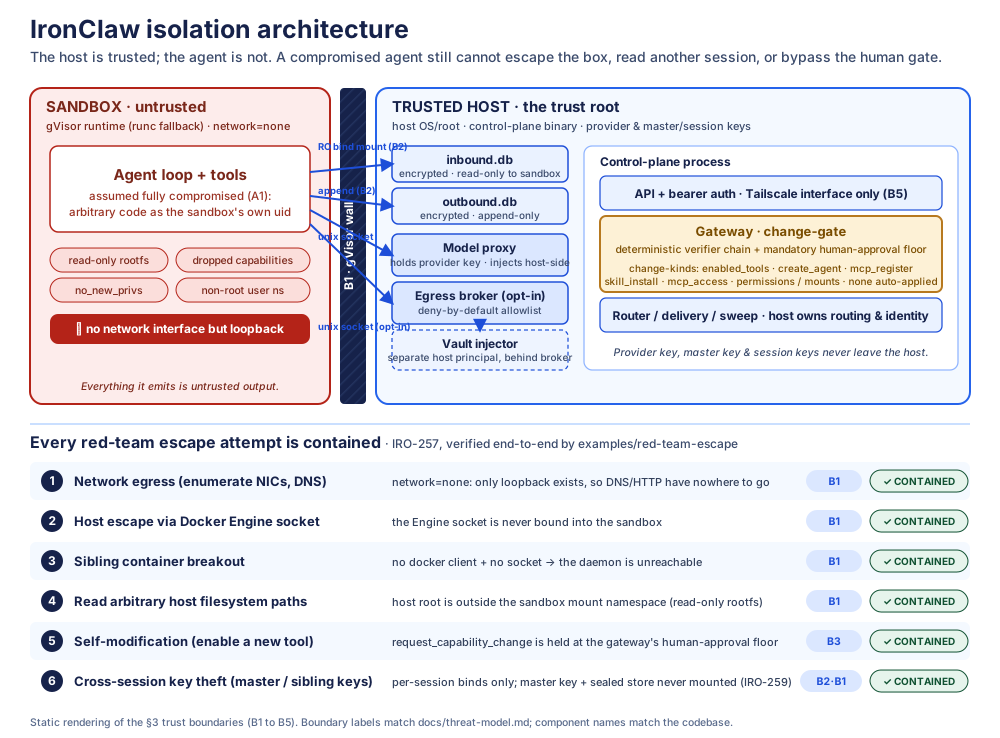
The wall itself is gVisor (runsc), a user-space kernel
that gives the agent a full Linux syscall surface while the real host kernel stays
behind a seccomp-bounded, capability-dropped boundary. Sandboxes run with
network=none, a read-only rootfs, no_new_privs, and a non-root user namespace.
The only crossings are two host-owned unix sockets (the model proxy that holds
your provider key, and the opt-in egress broker that is deny-by-default) plus the
per-session encrypted queues (inbound.db bound read-only, outbound.db
append-only).
For the design rationale behind this posture, why the host is trusted and the agent is not, and what gVisor buys over a plain container, see Why we run AI agents in gVisor.
What a compromised agent still cannot do
We do not just assert the wall holds. We attack it. The red-team escape harness stands up the offline demo control-plane, engages a real per-session sandbox, and then runs each attack below from inside that sandbox, as the sandbox's own user, exactly the privilege a jailbroken agent would have. It asserts each one is contained.
| # | Attack from inside the sandbox | What contains it | Boundary |
|---|---|---|---|
| 1 | Network egress: enumerate NICs, resolve DNS | network=none, so only loopback exists and a packet has nowhere to go |
B1 |
| 2 | Host escape via the Docker Engine socket | The Engine socket is never bound into the sandbox | B1 |
| 3 | Sibling container breakout | No docker client and no socket, so the daemon is unreachable | B1 |
| 4 | Read arbitrary host filesystem paths | Host root is outside the sandbox mount namespace (read-only rootfs) | B1 |
| 5 | Self-modification: enable a new tool | The request is held at the gateway's mandatory human-approval floor | B3 |
| 6 | Cross-session key theft (master and sibling keys) | Per-session binds only; the master key and sealed store are never mounted | B1, B2 |
Every row is contained on the production gVisor posture. The self-modification
case (row 5) is the one worth dwelling on: an agent can ask to enable a new tool,
but it can never apply the change. The request lands on the encrypted outbound
queue, the host turns it into a change request, and the gateway holds it in
GET /v1/changes/pending until a human approves it. There is no bypass path.
The same harness runs as a continuous CI gate that also carries a negative control: it deliberately weakens the sandbox and asserts the harness catches the regression, so the gate can never go quietly blind.
Honest scope: the laptop demo relaxes two things
The zero-credential demo runs the runc fallback for laptop friendliness, which
shares the host kernel and (until the per-session bind fix, IRO-259, lands)
binds the whole state directory. The harness prints those as tracked gaps
rather than pretending they are closed. The network, Docker-socket,
sibling-breakout, and gateway boundaries hold identically on both paths.
See the harness README
for the full demo-versus-production accounting.
What the wall costs
Isolation is not free, but the cost is bounded and predictable rather than a tax on every operation. Numbers below are the profile you should expect; reproduce them with the harness in Performance and footprint.
| Dimension | Overhead versus a runc baseline |
|---|---|
| CPU-bound reasoning | Near-native, within a few percent. Work that stays in userspace barely touches the wall. |
| Memory per sandbox | A fixed additive cost, on the order of tens of MiB of RSS beyond the workload. |
| Sandbox start | A one-time additive cost of roughly a couple hundred milliseconds, per launch, not per request. |
| Syscall or I/O heavy bursts | The largest gap, often in the range of roughly 1.5x to 2.5x, because every syscall is mediated. This is the isolation you are buying. |
| Network throughput | Not applicable. Sandboxes run network=none with no NIC, so gVisor's weakest dimension is removed by design. |
The takeaway: agent reasoning runs near-native, per-sandbox memory is a roughly fixed cost so host capacity scales linearly with agent count, and the one real overhead sits on syscall-heavy bursts, which is exactly the mediation that makes the box a box.
Verify it yourself
-
One command, no credentials. It attacks a live sandbox from the inside and prints a PASS or FAIL table.
-
The full boundary-by-boundary STRIDE analysis behind the diagram, and what counts as a vulnerability.
-
The measured overhead, the methodology, and how to run it on your own host.
-
Every build is checksummed, keyless-signed with cosign, and carries build-provenance attestations.
For the invariants that hold across all of this, start at the Security and trust overview.